
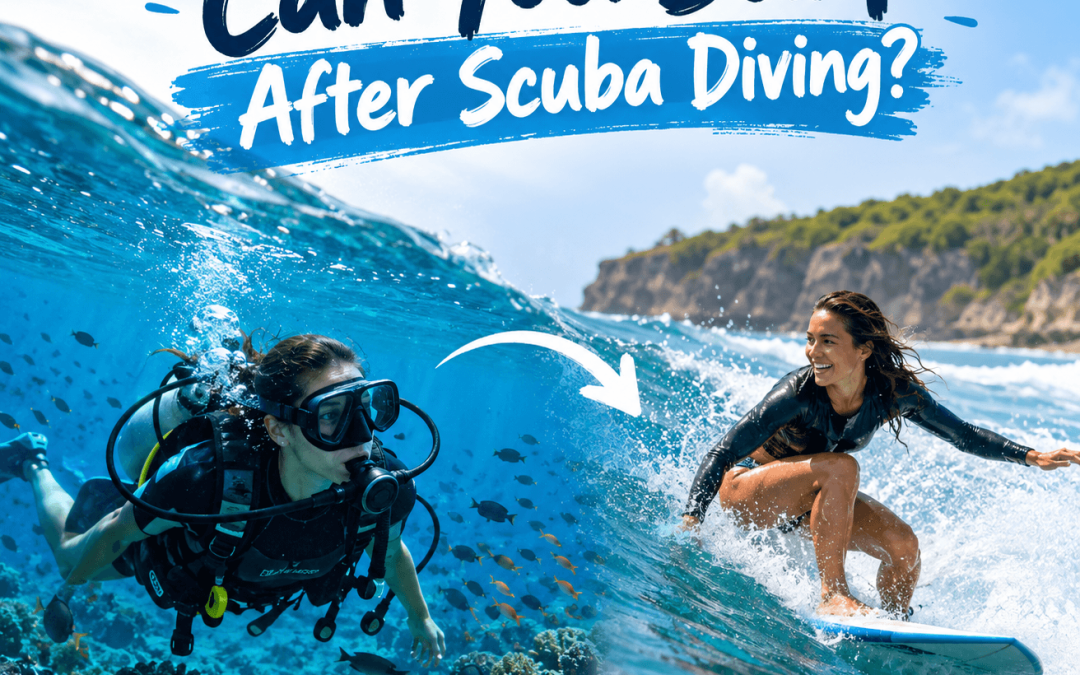
Can you go surfing after scuba diving? Yes, in many situations you can combine scuba diving and surfing during the same Bali trip — as long as you are physically fit, well-rested, properly hydrated, and give your body enough time to recover between activities.
Bali is one of the best destinations in the world for combining ocean adventures. In the same trip, you can explore coral reefs and underwater life with scuba diving and then experience the waves through surfing.
But there is an important question:
How long should you wait between scuba diving and surfing?
The answer depends on the type and intensity of both activities.
Can You Surf After Scuba Diving?
Surfing after scuba diving is not automatically prohibited. However, scuba diving and surfing are both physically demanding activities, and doing them back-to-back without enough recovery can leave you tired, dehydrated, or less alert in the water.
After a scuba dive, your body is still eliminating inert gas absorbed during the dive. Because of this, divers should be conservative about strenuous exercise after diving.
The Divers Alert Network (DAN) recommends avoiding intense physical training for 24 hours after diving and limiting exercise during the post-dive period.
For that reason, if you plan to scuba dive and surf on the same day, don’t treat it as a race to fit everything into your schedule.
Give yourself time to rest, eat, hydrate, and recover before getting back into the ocean.
How Many Hours Should You Wait Between Scuba Diving and Surfing?
There is no universal number of hours that makes surfing after scuba diving automatically safe for everyone.
A short and easy surf session is very different from paddling hard for several hours in strong waves.
As a conservative approach, allow several hours of recovery between scuba diving and surfing, especially after a deeper, longer, or repetitive dive.
If the planned surf session is going to be physically demanding — for example, long paddling sessions, strong currents, bigger waves, or an intensive surf training session — waiting until the next day can be the more sensible option.
Your physical condition matters too.
If you feel tired, dizzy, dehydrated, unusually short of breath, or simply don’t feel 100%, skip the second activity.
The ocean will still be there tomorrow.
What If You Surf First and Scuba Dive Later?
The order can also be reversed.
You can surf first and scuba dive later, but the same principle applies: don’t start a dive when you are exhausted from surfing.
Surfing can involve a lot of paddling, repeated duck dives, swimming against currents, and prolonged physical effort.
If you have spent several hours surfing, take enough time to recover before putting on your scuba gear.
Before diving, make sure you are:
- Properly hydrated
- Well rested
- Not overheated
- Not physically exhausted
- Comfortable in the water
- Mentally alert
- Fit enough for the planned dive
Remember that scuba diving requires you to manage equipment, buoyancy, breathing, and potentially changing conditions underwater. Fatigue can make these tasks more difficult.
Scuba Diving + Surfing in Bali: What Is the Best Way to Plan It?
If you want to experience both scuba diving and surfing during your Bali holiday, planning your activities on different parts of the day or on different days is usually the easiest approach.
Option 1: Scuba Diving in the Morning, Surfing Later
This is possible for a fit and experienced person, but don’t jump directly from your dive boat onto a surfboard.
After diving:
- Finish your dive safely.
- Follow your dive computer and dive plan.
- Eat and dehydrate.
- Rest for several hours.
- Assess how your body feels.
- Only surf if you feel fully recovered and the surf conditions are appropriate.
Keep the surf session easy rather than turning it into an intensive workout.
Option 2: Surfing in the Morning, Scuba Diving Later
This can also work if the surf session is moderate and you have enough time to recover before diving.
If your morning surf session leaves you exhausted, however, it is better to postpone the dive rather than forcing yourself through it.
Option 3: Separate Them by Day
For many travelers, this is the best option.
Day 1: Scuba diving
Enjoy your dive, relax, hydrate, and recover.
Day 2: Surfing
Wake up fresh and enjoy a longer surf session.
This gives you more energy for both activities and allows you to enjoy each experience without rushing.
Why Fitness Matters When Combining Diving and Surfing
Being comfortable in the water is not the same as being physically ready for two ocean activities in one day.
Surfing can require significant cardiovascular endurance and upper-body strength because of repeated paddling.
Scuba diving also involves carrying equipment, swimming, managing buoyancy, and dealing with currents or surface conditions.
That’s why your personal fitness level matters.
Someone who regularly swims, surfs, dives, or trains may recover faster than someone who is not accustomed to prolonged physical activity.
But fitness doesn’t eliminate the need for recovery.
Even experienced divers and surfers need rest.
Stay Hydrated Between Diving and Surfing
Hydration is particularly important when combining outdoor activities in Bali.
The tropical climate, sun exposure, sweating, travel, and physical activity can all contribute to dehydration.
After scuba diving, make hydration part of your recovery routine before considering another activity.
Drink water, eat properly, stay out of excessive heat, and give your body time to cool down.
Avoid turning your surface interval into another workout.
Listen to Your Body
One of the simplest rules when combining scuba diving and surfing is:
If you don’t feel good, don’t go.
Don’t surf because your friends are going.
Don’t dive because you already booked the boat.
And don’t push yourself just because you traveled all the way to Bali.
If you feel unusually tired or unwell after diving, take the day off.
If you experience symptoms that could indicate a diving-related medical problem after scuba diving, don’t continue with strenuous water activities and seek appropriate medical evaluation.
Safety should always come before squeezing one more activity into your holiday.
Bali: Why Combine Scuba Diving and Surfing?
Bali makes it easy to build a trip around different ocean experiences.
You can spend one day exploring coral reefs, tropical fish and underwater landscapes, and another day learning how to read waves, paddle and catch your first wave.
At Bali Diving School, you can start your Bali underwater adventure with scuba diving courses and guided diving experiences. Bali Diving School offers PADI and SSI training, from beginner programs through advanced and professional-level courses.
After exploring Bali underwater, you can continue your ocean adventure on the other side of the surface.
From Scuba Diving to Surfing: Continue Your Bali Ocean Adventure
If scuba diving gives you a chance to explore what’s underneath the ocean, surfing lets you experience the energy of the ocean from above.
For travelers who want to take their surfing further, Kala Surf in Uluwatu offers surf programs for different experience levels, from beginners to advanced surfers. Their programs include surf coaching, guiding, video analysis, mobility training and surf-focused activities.
Kala Surf beginner program is designed for people who have never surfed before, while more advanced levels focus on green waves, turns, wave selection and advanced surfing skills.
So your Bali adventure can look something like this:
Scuba diving with Bali Diving School → Rest & recover → Surfing with Kala Surf
Or better yet:
Dive. Rest. Surf. Repeat.
Just remember that the goal isn’t to fit as many activities as possible into one day. The goal is to enjoy Bali’s ocean safely and come home with great memories.
Ready to Experience Both?
Start your underwater adventure with Bali Diving School, then head to Uluwatu and continue your ocean journey with Kala Surf.
Whether you’re interested in scuba diving, learning to surf, or building a full Bali ocean adventure, combining both experiences can make your trip much more memorable.
Explore scuba diving in Bali with Bali Diving School:
Bali Diving School
Continue your surf adventure at Kala Surf:
Kala Surf (Surfing Camp Bali)
reservation@kala.surf
+62 813‑3663‑146
Jl. Labuansait 318, Uluwatu, 80361 Bali, Indonesia
Recent Comments