
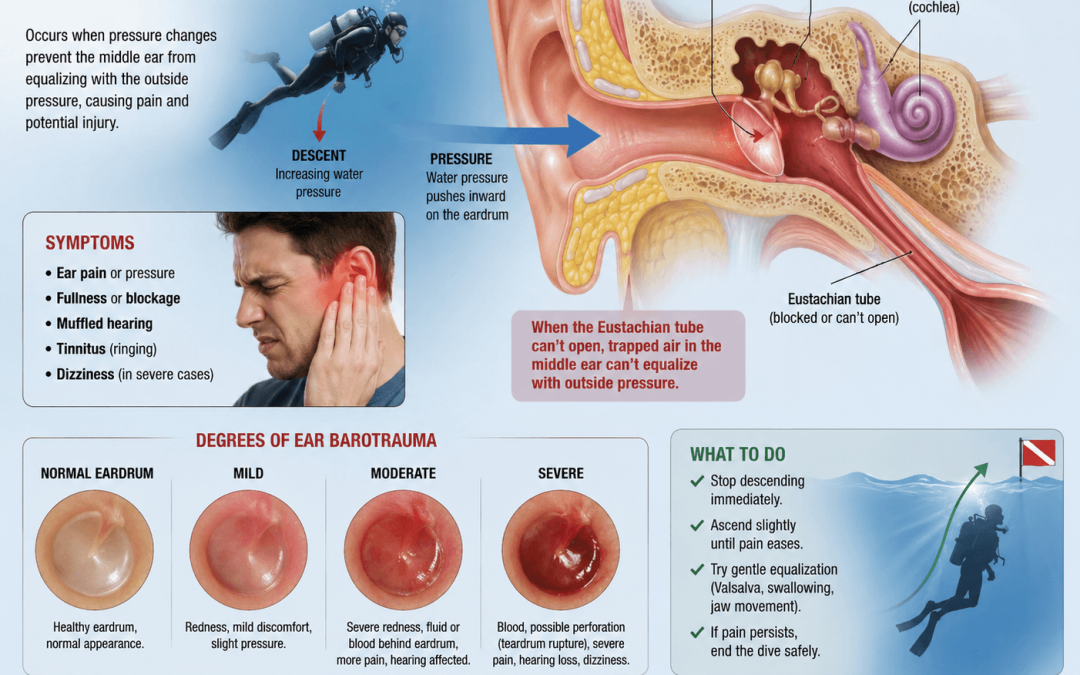
Ear pain while diving usually happens because the pressure in your middle ear isn’t equalizing properly as you descend. This is called ear barotrauma or an ear squeeze.
As you go deeper, water pressure increases and pushes your eardrum inward. Normally you equalize by gently sending air through the Eustachian tubes—using Valsalva, swallowing, jaw movement, or Frenzel.
What may be happening
- Mild squeeze: pressure, fullness, discomfort, muffled hearing.
- Moderate barotrauma: sharper pain, blocked ear, fluid or blood behind the eardrum.
- Reverse block on ascent: pain gets worse while going up because trapped air cannot escape easily.
- Inner-ear injury (more serious): sudden severe pain, vertigo/spinning, nausea, ringing, hearing loss, or imbalance.
What to do underwater
- Stop descending immediately.
- Ascend a little until the pain eases.
- Try gentle equalization—never force it.
- If it still will not clear, end the dive safely. Do not “push through” ear pain.
After the dive
Avoid diving again until the ear feels fully normal. See an ENT or dive-medicine doctor promptly if you have:
- pain lasting more than a day,
- hearing loss or strong muffling,
- ringing,
- dizziness/vertigo,
- fluid, pus, or blood from the ear,
- fever or worsening pain.
Also avoid diving when you have a cold, sinus congestion, allergy flare-up, or ear infection—those make equalization much harder.
Big rule for divers: equalize early, equalize often, and never force it.
Recent Comments